CrossFit without equipment: how to train at home with your bodyweight
CrossFit without equipment: which bodyweight exercises to build on, a 10-minute AMRAP for a small flat, the common mistakes and how to progress. Try it today.
 Sergey Titov 7 min read
Published · updated
CrossFit without equipment is training where your body is the resistance and the format sets the intensity: AMRAP, EMOM, rounds for time. A barbell and rings give you more options, but they are not what makes CrossFit work. In a flat, with no gear, you can build strength, endurance and coordination — provided you pick the right bodyweight exercises and do not try to replace load with chaos. This guide shows what to build a no-equipment session from, gives you a complete 30-minute workout with a 10-minute bodyweight AMRAP, and explains how to make it harder week by week.
What you will get from this guide
- The principles that keep home CrossFit without gear effective.
- A table of the basic movements by pattern, each with an easier and a harder version.
- A full session — warm-up, strength block, AMRAP 10 and cool-down — with reps and rest.
- The mistakes that turn a bodyweight CrossFit workout into empty fatigue, and a six-week progression plan.
CrossFit without equipment: why it works
Training load is not only weight. It is also volume (how many reps), density (how much work per minute) and movement difficulty. Without dumbbells you cannot add kilograms, but you can shorten the rest, raise the tempo and move to a harder version of the exercise: from knee push-ups to full push-ups, from full push-ups to diamond push-ups. That is how the load climbs in the Start course too, session by session, with nothing but a mat and a chair.
The second tool is the format. A ten-minute AMRAP of burpees and squats taxes your heart and lungs harder than thirty minutes of leisurely sets. The WHO recommends adults get 150–300 minutes of moderate activity per week or 75–150 minutes of vigorous activity; short, dense workouts hit the second target quickly but need a rest day in between. For the same reason the ACSM advises novices not to load the same muscle groups more often than every 48 hours.
Who it suits and when to see a doctor
Bodyweight training suits almost everyone, but if you have a heart condition, high blood pressure, joint or back pain, are pregnant or carry a lot of extra weight, talk to a doctor first and replace jumps with steps. If you are starting from zero, read the guide to CrossFit at home for beginners first: it lays out the first four weeks day by day.
Bodyweight exercises: the base of every no-equipment WOD
Build a workout from patterns, not from favourite exercises. Each pattern has three rungs, so you can always make the session easier or harder.
| Pattern | Easier | Base | Harder |
|---|---|---|---|
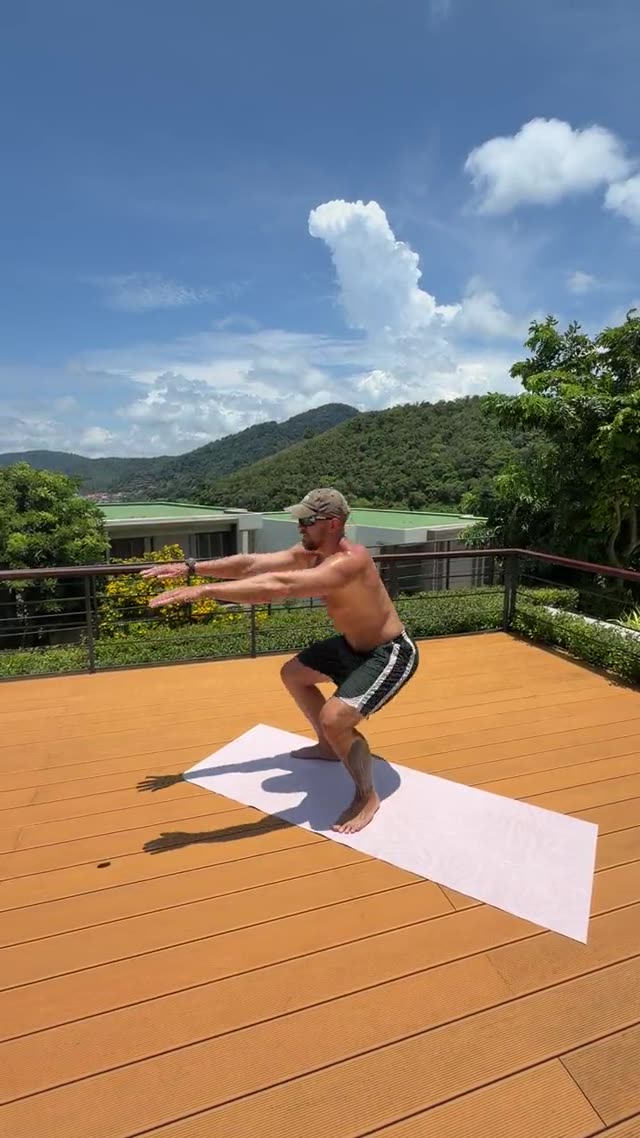
| Squat | Wall sit | Air squat | Jump squat |
| Hinge | Glute bridge | Single-leg glute bridge | Single-leg Romanian deadlift |
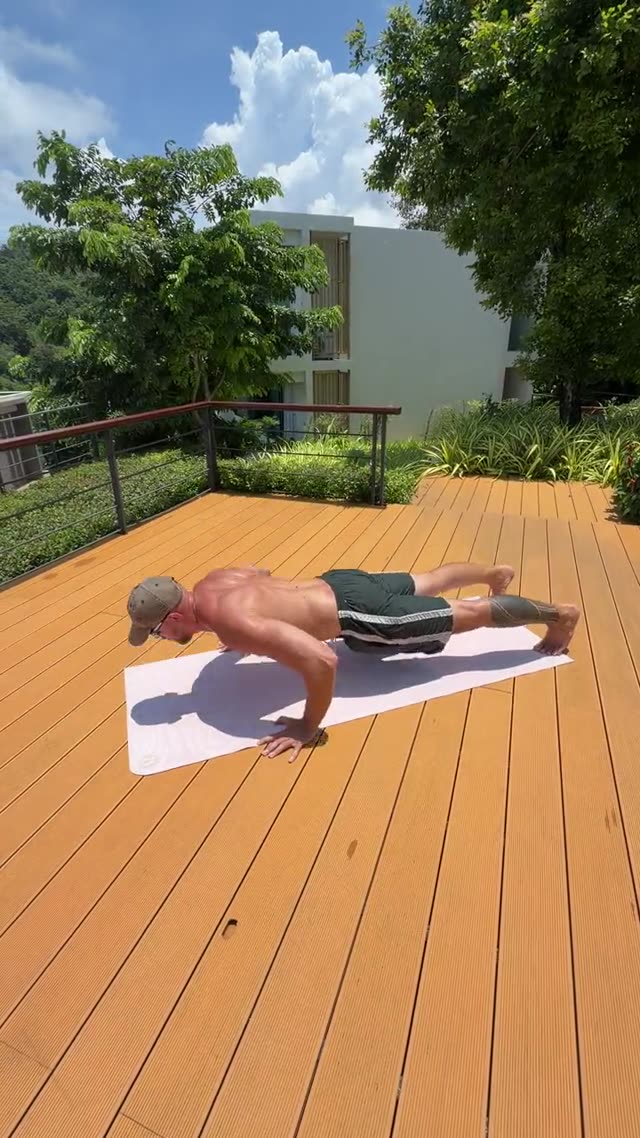
| Push | Knee push-up | Push-up | Pike push-up |
| Lunge | Reverse lunge | Lateral lunge | Jumping lunge |
| Core | Dead bug | Plank | Hollow hold |
| Full body | Half burpee | Burpee | Burpee with a jump over an imaginary line |
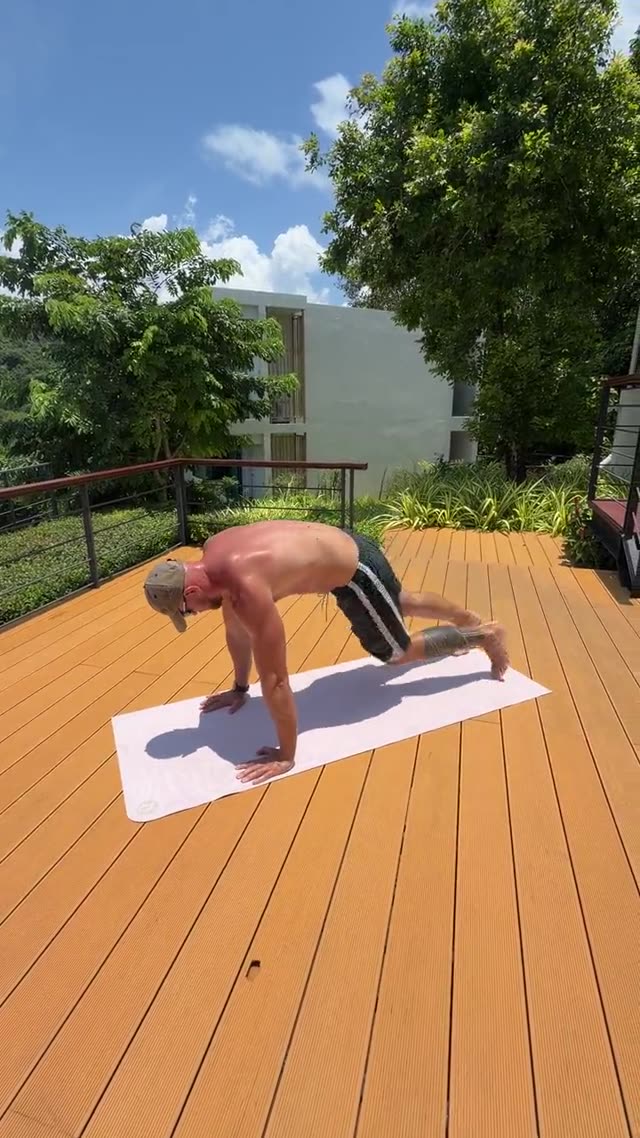
| Cardio | Jog in place | Jumping jacks | Mountain climbers |
A good no-equipment WOD takes one movement from three or four different rows. Two squat exercises back to back is tired legs, not a full-body session.
Formats that work at home
- AMRAP — as many rounds as possible in a fixed time. The best home format: one timer, easy counting, and the load self-adjusts to your level.
- EMOM — a new task every minute, the remainder of the minute is rest. Teaches pacing.
- For time — a fixed amount of work against the clock with a cap. Needs experience: beginners break their form here most often.
- Tabata — 8 rounds of 20 seconds of work and 10 seconds of rest, four minutes per exercise.
Each format, with examples and typical mistakes, is covered in the AMRAP, EMOM, For Time and Tabata guide.
Sample workout: 30 minutes, no gear
This is a “base” level session: you can already squat to parallel and do at least five push-ups from the floor. If not, take the easier column from the table.
Warm-up — 2 rounds, no rest:
- Jog in place — 45 seconds.
- Arm circles — 30 seconds.
- Leg swings — 10 per leg.
- Squat to stand — 6 reps.
Strength — 3 sets, 60 seconds of rest between sets:
- Reverse lunges — 12 reps (6 per leg).
- Push-ups — 8 reps, chest to the floor.
- Superman — 10 reps with a one-second pause at the top.
Metcon — AMRAP 10 minutes:
- 5 burpees
- 10 air squats
- 10 mountain climbers
- 20 jumping jacks
The task is not to empty the tank in the first two minutes but to find a pace you can hold for all ten. Rest when you need to, standing rather than lying down. Write down the full rounds plus the reps of the last partial round: that is your benchmark for next time.
Cool-down: hip flexor stretch — 30 seconds per side, hamstring stretch — 30 seconds per side, child’s pose — 45 seconds.
How the app scales it
In Forma this session looks different for different people. The questionnaire on first login and the short test after your second workout set a volume multiplier between 0.6 and 1.3: one person gets 5 push-ups in the strength block, another gets 10. For a level-one user the app automatically swaps exercises for the easier rung of the same chain: burpees become half burpees, push-ups become knee push-ups. The AMRAP length never changes — ten minutes stay ten minutes — but the reps per round rise or fall with the multiplier. Before the session you can choose easier (a set fewer in one or two blocks, reps down about 10 %) or harder (a set more, reps up about 10 %), with rest between sets unchanged, and afterwards you rate the effort from 1 to 10. From that rating and the share of work you completed, the app decides what to do with the next session.
Common mistakes
- Burpees every day. The same movement six times a week overloads the shoulders and wrists and adds nothing to your legs. Alternate strength days and metcons.
- Speed over form. In an AMRAP only full reps count. A quarter squat or a push-up with a sagging lower back is a zero.
- Cardio only. A workout with no strength block will not make you stronger. Sets with 60 seconds of rest and a slow tempo matter as much as the timer.
- Jumping on unprepared joints. Jumping lunges and tuck jumps are level-three movements. Earn a quiet landing in the regular jump squat first.
- The same AMRAP for months. The body adapts within three to four weeks. Change the movements, the format and the time cap, or progress stalls.
How to progress
Progress without equipment is measured three ways: a harder version of the movement, more rounds in the same time, shorter rest. Move one lever at a time.
- Weeks 1–2. Base versions from the table, AMRAPs of 6–8 minutes, two strength days and one interval day. Log your rounds.
- Weeks 3–4. Knee push-ups go, air squats alternate with jump squats, the AMRAP grows to 10–12 minutes and the first 12-minute EMOM appears. If the burpee is the hard part, there is a dedicated burpee technique guide.
- Weeks 5–6. Hollow hold instead of the plank, diamond push-ups, jumping lunges. Repeat your first AMRAP and compare the rounds — more honest than any feeling.
- After that. Once you can do more than twenty full push-ups and more than forty squats in a minute, your bodyweight stops being enough resistance. That is when a pair of dumbbells or a kettlebell makes sense; what to buy first is covered in the home equipment guide. And if time is your constraint, there is a set of 20-minute workouts.
Wrap-up
CrossFit without equipment rests on three things: patterns instead of random exercises, a strength block plus a metcon in a fixed format, and progression from the easy version of each movement to the hard one. All of it is packaged in the Start course: twenty short sessions with no equipment and a load that adapts to you — and between them the Small Steps Club in the app keeps you going with one task a day.
FAQ
Can you build strength without dumbbells or a barbell?
Yes, up to a point: until you can do 20 full push-ups and 30 squats in a row, your bodyweight is enough resistance. Load goes up through harder versions of each movement, slower tempo and shorter rest.
How many no-equipment workouts a week?
Three to four sessions a week with a rest day between the intense ones. Alternate strength days and metcons rather than doing a burpee AMRAP every day.
What if I cannot jump because of downstairs neighbours?
Swap every jump for a step: jump squats become squats with a pause at the bottom, burpees become half burpees stepping back, jumping jacks become jogging in place. Keep the intensity with tempo and short rest instead.
How is CrossFit without equipment different from a regular home workout?
Structure and intensity: there is a strength block with sets and rest, a metcon in a fixed format with a timer and a round count, and the load rises week to week. A generic routine gives you none of that.