CrossFit at home for beginners: how to start without getting hurt
CrossFit at home for beginners: how to start with no equipment, a complete first workout, the common mistakes and a four-week plan. Read it and start today.
 Sergey Titov 6 min read
Published · updated
CrossFit at home for beginners is not box jumps and a barbell overhead. It is three short sessions a week built on four movements you can learn in a living room: the squat, the hip hinge, the push-up and the plank. Every gym program starts from those same patterns, and you can own them safely in a two-by-two-metre space with a chair and a wall. If you are wondering how to start CrossFit at home, this guide covers what your first workout looks like, the mistakes almost every beginner makes and where to go once the basics feel easy.
What you will get from this guide
- A plain explanation of what CrossFit for beginners actually is at home and how it differs from “doing some exercise”.
- The six movements to learn before you add anything harder.
- A complete first workout with exact reps and rest — built on the same logic as the first block of the Start course.
- The common mistakes and a progression plan for your first four weeks.
CrossFit at home for beginners: where to start
CrossFit is general physical preparedness: strength, endurance, mobility and coordination trained in one program instead of four separate ones. In a gym that means barbells, rings and rowers. At home it means the floor, a chair and a wall. The principle does not change: basic movements, varied formats, gradual progression. Before you build a home workout plan for beginners, answer three questions honestly.
How many days a week
Three sessions a week with a rest day between them is the right dose for a beginner. The ACSM recommends that novices leave 48–72 hours between sessions loading the same muscle groups — that is when the adaptation actually happens. The WHO guideline for adults is 150–300 minutes of moderate activity per week plus muscle-strengthening work on at least two days. Three 30-minute home sessions and a walk on the other days cover that without heroics.
What equipment you need
None. A mat is optional. A sturdy chair gives you incline push-ups and step-ups; a wall gives you the wall sit. Everything else happens on the floor. A bodyweight CrossFit session is not a compromise: until you can do twenty clean squats in a row a barbell would only get in the way, and twenty clean squats is your first goal.
When to see a doctor first
Talk to a doctor before you start if you have a heart condition, high blood pressure, joint or back pain, are pregnant, or have not trained in years and are over forty. A program should work around your limits, not pretend they do not exist.
Six movements to learn first
A beginner CrossFit workout is built from six patterns. Learn each in its simplest version and every workout after that becomes accessible.
| Pattern | Exercise | What it trains |
|---|---|---|
| Squat | Air squat | Thighs, glutes, ankle mobility |
| Hinge | Glute bridge | Glutes, hamstrings, lower back |
| Push | Knee push-up | Chest, shoulders, triceps |
| Lunge | Reverse lunge | One leg at a time, balance |
| Core | Plank | Trunk stability, lower-back protection |
| Locomotion | Jog in place | Heart rate, warm-up, transitions |
The rule for the first two weeks: no jumping. Burpees, jump squats and rope work come once your knees and ankles have adapted to the volume. The Start course has no jumps at all: twenty workouts in four blocks of five, built on squats, push-ups, lunges, step-ups, dead bugs and inchworms.
Your first workout
This is a workout for your first day; in the Start course day one has no max-effort test either: work by the timer, a new movement every minute and rest until the minute is up. With the warm-up and cool-down it takes about 30 minutes. The strength block is slow: two seconds down, one second up; if your form breaks, end the set early.
Warm-up — 2 rounds, no rest:
- Jog in place — 45 seconds, marching is fine.
- Arm circles — 30 seconds.
- Squat to stand — 6 reps.
- Inchworm — 4 reps.
Strength — 3 sets, 60 seconds of rest between sets:
- Air squats — 10 reps, heels down, knees pushed out.
- Incline push-ups — 8 reps, hands on the chair seat, body in one straight line.
- Wall sit — 20 seconds, thighs parallel to the floor or slightly higher.
Core — 2 rounds, 30 seconds of rest between rounds:
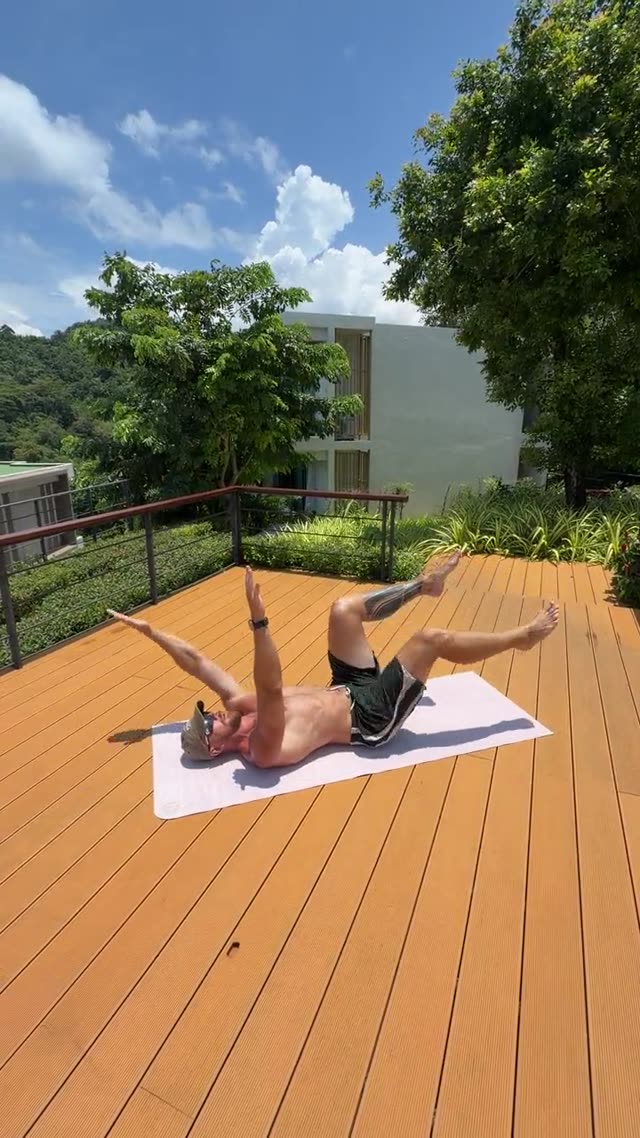
- Dead bug — 8 reps per side.
- Plank — 20 seconds.
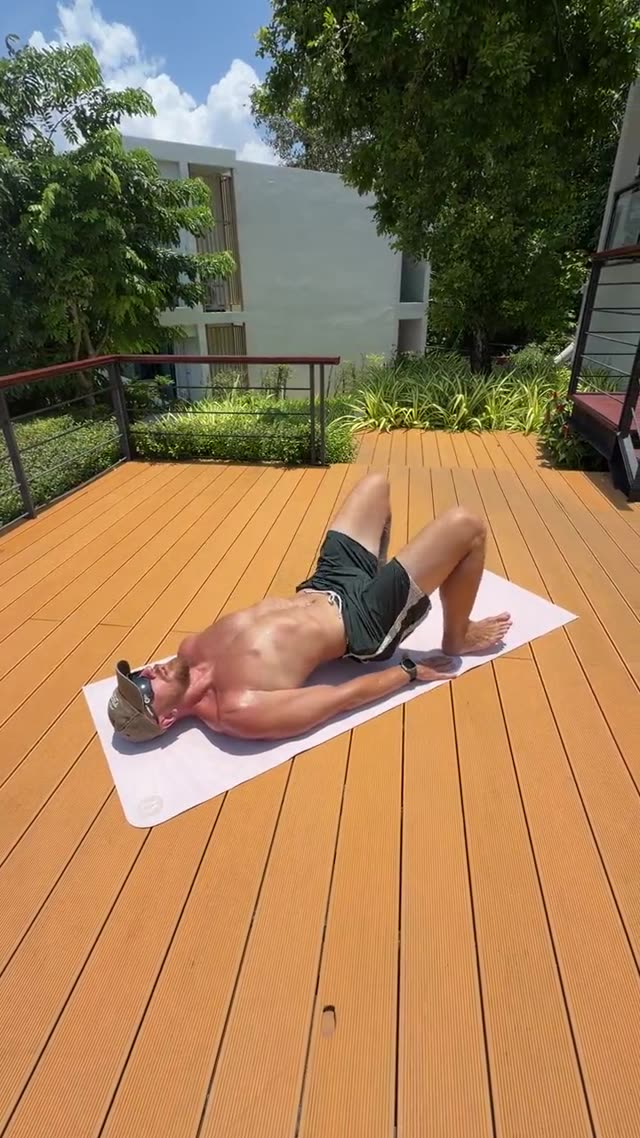
- Glute bridge — 12 reps with a pause at the top.
Cool-down: cat-cow — 6 reps, hamstring stretch — 40 seconds per leg, child’s pose — 45 seconds.
How the app scales it
On first login Forma asks a few short questions, and after your second workout the app offers a short test: squats, push-ups, sit-ups, lunges and a plank. The answers and the test produce a fitness index, and the index sets your volume multiplier — anywhere from 0.6 to 1.3. A beginner with a weak test gets 6 squats per set instead of 10; someone arriving with a base gets 13. Before each session you can pick easier or harder (a set fewer or more in one or two blocks, reps down or up about 10 %, rest unchanged), and afterwards you rate the effort from 1 to 10. Finished everything at an easy effort? The next session grows a little. Struggled, or something hurt? The volume drops, and the app tells you to back off and to see a professional if the pain persists.
Common beginner mistakes
- Starting with burpees and jumps. Knees and ankles are not ready and the squat is not clean yet. Squat first, jump later.
- Skipping the warm-up. Five minutes of jogging in place and arm circles are not a formality; they are shoulder and lower-back injury prevention. How to build one is covered in the warm-up guide.
- Chasing numbers. Ten squats to parallel beat twenty half squats. Only clean reps count — in the test and in the session.
- Training every day. Strength is built on rest days. Instead of a fourth session, take a 7 000-step walk. The workout count in the app does not reset on a rest day, so rest without worrying.
- Quitting in week two. The first result is not visible muscle; it is sets that stop feeling like punishment. Give the program four honest weeks, then retest.
How to progress
Progress for a home beginner is not “more rounds”; it is a steady climb through harder versions of the same movements. Use this order.
- Weeks 1–2. Technique and volume: the same exercises with a few more reps. Incline push-ups become knee push-ups, the plank grows from 20 to 40 seconds, the bridge from 12 to 15 reps.
- Weeks 3–4. Reverse lunges, supermans and the first short AMRAPs of 6–8 minutes appear. What those formats mean and how to count rounds is explained in the AMRAP, EMOM and Tabata guide.
- After four weeks. Retest. If you squat noticeably more in a minute and hold the plank longer, the base is there. Next come half burpees and jump squats; and if you want to set the base first, go through the Start course, where AMRAP, EMOM and a long chipper for time arrive one at a time.
If push-ups are your sticking point, there is a separate push-up progression guide. And for building workouts from whatever is in the room, read the guide to CrossFit without equipment.
Wrap-up
CrossFit at home for beginners means three sessions a week, six basic movements and honest reps with no jumping for the first two weeks. Start with the first workout of the Start course: the app sets the volume for you and adjusts it from your feedback after every session.
FAQ
Can I do CrossFit at home with zero experience?
Yes, as long as you start with the basic movements and no jumping: squats, incline push-ups, glute bridges and planks. Three short sessions a week with a rest day in between is a safe starting dose for a beginner.
How long should a beginner session be?
About 30 minutes including the warm-up and cool-down. The strength block takes 10–12 minutes, a short core circuit another 5–6, and the rest is joint preparation and stretching.
Do I need to buy any equipment to start?
No. For the first four weeks you need the floor, a sturdy chair and a wall. Dumbbells or a kettlebell start to make sense once you can do twenty clean squats and ten push-ups in a row.
When should I add burpees and jumps?
Not before week three, and only once your squat is clean: heels down, knees tracking over the toes. Until then replace burpees with half burpees stepping back and jump squats with regular squats.
What if my knees or lower back hurt after a session?
Muscle soreness fades in a day or two; joint pain or a sharp pain in the back is a reason to reduce the load and see a doctor. Mark the session as painful in the app and the next one will be scaled down.